


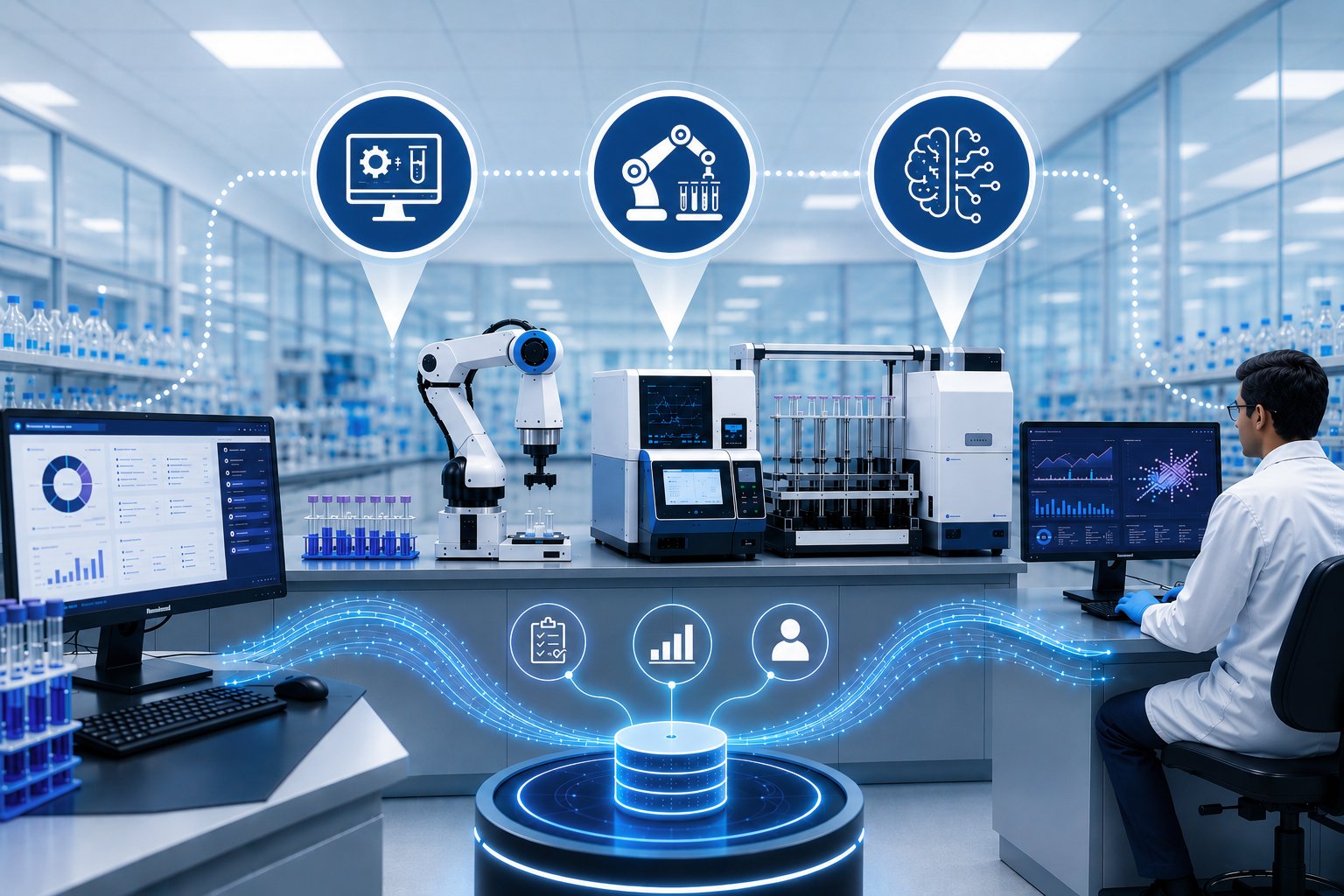
Building the Connected Laboratory of Tomorrow
Laboratories are generating more data than ever before. From sample registration and instrument readings to quality checks, approvals, and reporting, every stage of the laboratory workflow produces valuable information.
But having data is not the same as having a connected laboratory.
This is where three technologies are becoming increasingly important:
LIMS + Automation + AI
Individually, each can improve laboratory operations. Together, they can create a more connected, efficient and intelligent laboratory ecosystem.
What Does Each One Do?
1. LIMS — The Digital Backbone
A Laboratory Information Management System (LIMS) manages laboratory data and workflows.
It can help manage:
- Sample registration
- Sample tracking
- Test assignments
- Results
- Approvals
- User access
- Audit trails
- Inventory and consumables
Think of LIMS as the central information and workflow layer of the laboratory.
It answers: What happened, where, when and by whom?
2. Automation — The Hands That Execute
Laboratory automation reduces repetitive manual activities and enables instruments and systems to perform defined tasks consistently.
Examples include:
- Automated sample preparation
- Automated liquid handling
- Robotic sample movement
- Automated dispensing
- Instrument-to-LIMS data transfer
Automation can reduce repetitive manual work while improving consistency and throughput.
It answers: How can this task happen faster and more consistently?
3. AI — The Intelligence Layer
AI adds another dimension: analysis, prediction and decision support.
Depending on the application, AI can potentially help with:
- Identifying unusual results
- Detecting patterns in historical data
- Predictive maintenance
- Trend analysis
- Workload forecasting
- Decision support
AI answers:
What does the data tell us, and what could happen next?
The Connected Laboratory
The real value doesn’t come from implementing three technologies separately.
It comes from connecting them.
A simplified model looks like this:
Sample → LIMS → Automation → Instruments → Data → AI/Analytics → Human Review → Decision
This creates a continuous flow of information rather than isolated systems.
At ALS, we believe the future of laboratory design is not just smarter equipment. It is smarter integration.
From laboratory consultation and planning to equipment, infrastructure and future-ready solutions — ALS helps laboratories build for what they need today and what they may need tomorrow.